

Many people have dreamed of becoming an astronaut – drawn by the potential thrill of zero gravity or the novelty of space ice cream.
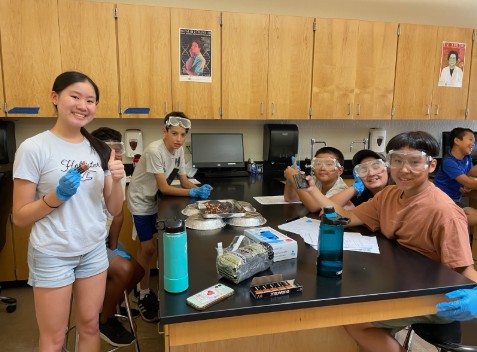
A group of 12 St. Francis High School girls are still holding onto that dream, although it won’t be them going into space – instead, it will be their experiment, which must fit inside a box the size of a mini sodacan.
The Program
The International Space Station Program was developed by Quest for Excellence, an organization that immerses students in the experience of working within an aerospace corporation – guiding them through every stage of experiment development from concept and design to construction and implementation.
“They’re trying to get their system to work to the point of being able to launch to the ISS,” said Howell Ivy, an Air Force veteran and founder of Quest for Excellence. “Essentially it’s a major learning experience that you don’t have access to as a high school student, or even a college student, because it gives you all the problems and solutions that the STEM industry has.”
In 2011, Quest launched its first experiment to the ISS on a Japanese cargo spacecraft. Since then, Quest has grown, partnering with more than 50 schools from across the world including in the United States, Australia and Indonesia.
“The best experience is watching all the teams launch their experiments,” Ivy said. “It happens once a year when the rocket goes up to the ISS. It’s a combination of hard work and successful moments for all the students.”
Bringing ISSP to St. Francis
John Moran, who joined St. Francis as president this school year, worked hard to bring a program that he has overseen for 13 years to St. Francis.
“I saw the power of the program and how it transformed the learning and development of students, so I was eager to bring it here this first year,” Moran said. “We were fortunate and blessed to get a mentor for the program right away, to find a high interest in the program among students and to partner with the Sacramento State University School of Engineering.”
Applicants were required to answer questions about why they wanted to join the International Space Station Program and what skills they believed they would be able to bring to the table. Four St. Francis students from each grade were selected including Megan Atkinson, a current junior.
“When I first saw my acceptance email, I thought it was a mistake and that something horrible had happened,” Atkinson said. “Then I calmed down, and I got really happy and started to jump around and dance. I told my parents and my sister and they were shocked. I don’t think they really understood what the experiment was asking.”
Designing the Experiment
Every major corporation and government entity has its own name – NASA, SMUD, SpaceX. The girls at St. Francis chose The Astras. Their slogan: “Add astra per aspera” – “To the stars through hardships.”
In order for an experiment to be sent to the International Space Station, students must meet strict guidelines. Despite this, there are no restrictions on the subject matter of the experiment, The students at St. Francis were given just under a month to conceptualize a feasible experiment.
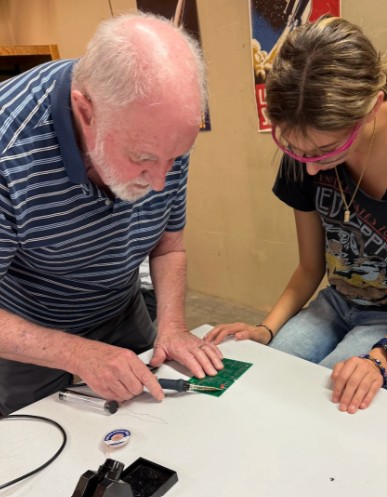
“We initially did not want to do a biological experiment because of the complicated nature of sending biology into space, but we got an offer from a company called Wainamics to test out their microfluidic chip,” Atkinson said. “We’re putting yeast inside this microfluidic chip which will provide nutrients and monitor how yeast growth is affected in microgravity.”
Since deciding on an experiment, the St. Francis ISSP members have broken up into groups, responsible for different components of the program – engineering, software, mechanical design and biological organism constraints.
“As part of the engineering team, we have to learn how to draw the schematics for all the electrical components of the experiment including the camera, LED light and pump, all which will have to fit inside a 2x2x4.75 inch box called a nanoncube,” Atkinson said. “On top of that, NASA only supplies a limited amount of power to our nanocube, so we have to make sure that not all the components are on at the same time.”
Applied Learning in Action
Moran describes the ISSP as a prime example of applied learning, something his generation didn’t have the opportunity to use as much.
“Tell me, I forget; show me, I remember; involve me, I learn,” Moran said. “ISSP forces students to put their classroom book knowledge into practical application of building a real-world experiment. They have to build problem-solving skills, not just in a word problem, but in an actual physical experiment in an engineering challenge.”
Beyond overseeing the program as a whole, Moran helps to gain publicity for ISSP and show how his students are making an impact.
“I build partnerships that sustain the program,” Moran said. “The news stories, television spots and our own school stories help to bring recognition to the students and highlight them, as well as the value of the St. Francis STEM program.”
Looking to the Future
Beyond sending an experiment to space, the long-term goals of the St. Francis STEM program are ambitious. Moran hopes to add more to the STEM zone every year, turning the space that the ISSP shares with the St. Francis robotics team into a full-blown STEM lab.
“I really want to build our STEM programs into a magnet program for all of California,” Moran said. “People will come and learn and see how we do it and maybe it will inspire other schools to do the same.”
Ivy is already figuring out ways to adapt to different problems arising in the industry and coming up with creative solutions.
“The ISS will probably be decommissioned around 2030,” Ivy said. “Quest Institute will have to come up with an alternative to get our space experiments into orbit. It may mean another space station. I may mean a reentry capsule. We have four or five years to come up with a good answer. Even though the ISS is not forever, there’ll always be other opportunities.”
Among all the people who have been impacted by the International Space Station Program, there is one defining moment that they all remember.
“The first time I led the International Space Station Program, we flew out to Florida and walked three miles out on Cocoa Beach,” Moran said. “I watched the launch and when I saw that rocket take off and disappear into the clouds, it was a joyful and tearful moment for all of us.”
“And it’s hard to explain what I felt in that moment, but it was tremendous gratitude that my focus on applied education, especially in the STEM areas, had come to this pinnacle for young people.”
***
Editor’s note: SacSchoolBeat reporter Charlotte Hwang is part of the ISS Program at St. Francis High.